Scrappy Always Wins: Why Hospitality’s Future Belongs to the Nimble
May 22, 2026
How adaptability, people-first leadership, and a willingness to rethink the rules are helping hospitality operators thrive in an industry defined by constant change
By Andrew Carey, CEO
The hospitality industry has never been static. Change, disruption, and unpredictability are constant in our business. But over the past several years, the pace and intensity of that disruption has accelerated in ways few could have anticipated. Labor challenges, evolving guest expectations, shifting distribution channels, rapid technology advancement, and increasing operational complexity have all forced hotel leaders to rethink how they operate.
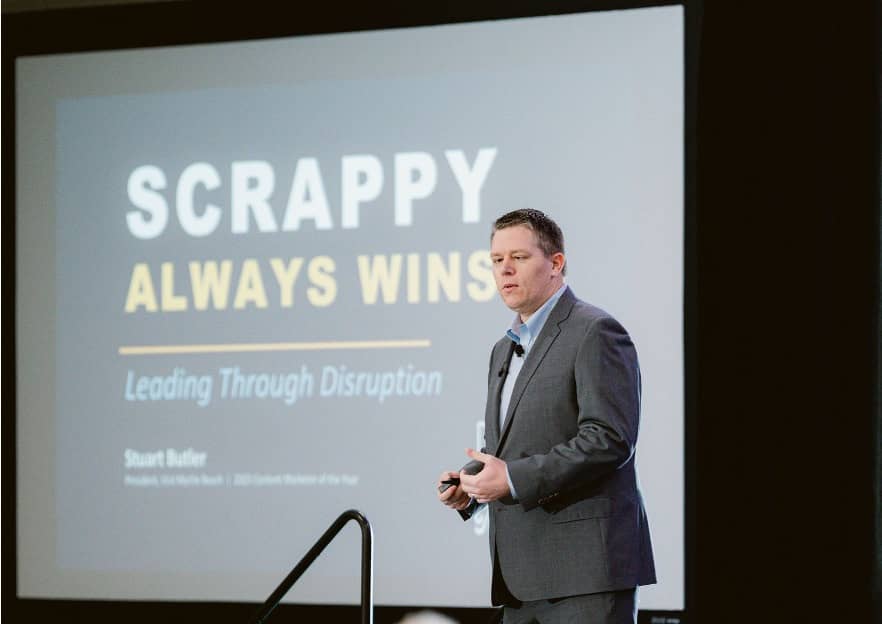
At Newport Hospitality Group’s recent Leadership Retreat, Stuart Butler, President of Visit Myrtle Beach, captured this reality perfectly during a session titled “Scrappy Always Wins.” His message resonated deeply with our leadership team because it framed an approach to winning in our dynamic industry: Success today belongs to organizations willing to adapt, rethink core assumptions, and compete differently.
Butler’s central theme was straightforward but powerful: in an uncertain world, leaders must focus on what they can control and influence. Instead of accepting the status quo, great operators reset the competitive landscape to take advantage of their own strengths.
That mindset is what he described as “scrappy.”
As a smaller hospitality company competing against large brands and management organizations, Newport has always had to operate this way. We have never had the luxury of relying solely on scale or corporate machinery. Instead, we have built our success on personal relationships, hands-on leadership, flexibility, and the depth of experience within our organization.
To me, being scrappy means refusing to let someone else define the rules for success. It also means flipping the script to accentuate your strengths rather than competing on someone else’s terms.
Personal, Accessible, & Adaptable Culture
For Newport, those strengths are clear. Our culture is deeply personal. Our leaders are accessible. Our hotel teams have direct access to experienced hospitality veterans who can help solve operational, sales, capital, and facility challenges in real time. There are very few organizations that can match the tenured depth of our teams or the intensity of our hotel-level engagement.
But scrappiness in hospitality goes beyond organizational structure. It’s ultimately about adaptability.
Our general managers and directors of sales operate in a living, breathing environment where no two days are alike. Guests arrive with different expectations, operational issues emerge without warning, and market conditions can shift overnight. Successful hotel leaders must think creatively, move quickly, and remain confident enough to tackle problems that rarely come with a clear roadmap.
That reality is why Butler’s message landed so effectively with our team. He understood something fundamental about hospitality professionals: We thrive in chaos, even if we do not always describe it that way. Hospitality has always been frenzied. The best operators know how to set a plan, then pivot when circumstances change.
Butler offered reassurance that this environment is not unusual. More importantly, it is manageable.
That realization resonated throughout the room during the session. Our leaders recognized that the challenges they face daily are not signs of failure or dysfunction. They are simply the modern operating conditions of hospitality. More importantly, they realized they already possess the tools, instincts, and experience needed to succeed.
Living Hospitality
In many ways, Butler’s message aligned naturally with Newport’s philosophy of Living Hospitality.
At its core, Living Hospitality means meeting guests where they want to be met and delivering the best possible experience to them in that moment. There is no universal formula for doing that successfully. Every interaction starts from zero. Every situation requires empathy, flexibility, and problem-solving.
You cannot truly deliver hospitality without a scrappy mindset.
The most effective hotel leaders understand that guest expectations are constantly evolving. Yesterday’s solutions will not solve tomorrow’s problems. Distribution strategies are changing in front of us. Recruiting, hiring, and retention are evolving rapidly. Brand relationships are becoming more fluid as new products and platforms emerge.
In this environment, clinging to old assumptions can become dangerous.
Hospitality leaders today must be willing to revisit first principles. We need to rethink how we define success, how we engage associates, how we operate hotels, and most importantly, how we serve guests. The organizations that succeed will be those willing to challenge traditional thinking and remain relentlessly focused on the needs, wants, and desires of the customer.
That mindset also requires emotional discipline.
One of Butler’s most important reminders was that leaders should focus their energy on the things they can control or influence rather than obsessing over forces beyond their reach. In hospitality, it is easy to become overwhelmed by economic uncertainty, operational pressures, or shifting consumer behavior. But effective leadership requires clarity, calmness, and perspective.
As leaders, we must approach every challenge with a clear understanding of the underlying issue and a willingness to adapt. When we maintain that focus, we can remain optimistic without losing realism.
Lessons Learned
Personally, Butler’s presentation reinforced many lessons I learned early in my career. My father often used short phrases to communicate big ideas. Two that have stayed with me are: “Chance favors the prepared mind” and “Life is a bouquet of consequences.” Both reflect the essence of the scrappy mindset. Success comes from preparation, adaptability, and the ability to break complex problems into manageable pieces.
Looking ahead, I believe the hospitality companies that thrive will not necessarily be the largest or most resourced; they will be the nimblest.
Technology will continue reshaping every aspect of our business, from revenue management and operations to recruiting and guest engagement. Stakeholder expectations will continue evolving. The pace of change will not slow down.
But hospitality has always been about people first.
The leaders who succeed will be those who remain grounded in service while staying flexible enough to evolve alongside their guests and teams. They will be the organizations willing to challenge old assumptions, embrace uncertainty, and build cultures where creative problem-solving is encouraged rather than feared.
In other words, the scrappy ones will win.